
Running out of working capital while waiting 30, 60, or even 90 days for clients to settle invoices is one of the most frustrating challenges a growing business can face. You have operational costs, payroll, inventory, and supplier bills that must be paid right now, yet your bank account remains tied up in accounts receivable. This cash flow gap forces many business owners to turn down lucrative contracts, delay expansions, or scramble for expensive emergency loans just to keep daily operations moving smoothly.
Understanding spot factoring vs whole ledger factoring gives you a clear path out of this cash crunch by converting unpaid invoices into immediate cash. Invoice factoring frees up your working capital so you do not have to wait on slow-paying customers, but choosing the wrong agreement can lead to unnecessary costs or restrictive contract terms. In this detailed comparison of spot factoring vs whole ledger factoring, we will break down how both options work, compare their costs and flexibility, and help you pick the perfect funding setup for your cash flow strategy.
The Basics of Invoice Factoring
Before analyzing spot factoring vs whole ledger factoring, it helps to understand how invoice financing operates at its core. Commercial factoring is not a standard bank loan. Instead of incurring debt on your balance sheet, you sell your receivables to a financing company (the factor) at a small discount in exchange for immediate cash.
The transaction generally follows a straightforward three-step mechanism:
- Invoice Submission: You deliver goods or perform services for a commercial customer and issue a standard invoice. You then send a copy of that unpaid invoice to your factoring partner.
- Initial Cash Advance: The factor advances an initial percentage of the invoice face value, typically between 80% and 95%, into your business bank account within 24 to 48 hours.
- Final Settlement: Your customer pays the factoring provider according to their standard credit terms. Once payment settles, the factor sends you the remaining balance (the reserve) minus their agreed-upon service fee.
Invoice factoring relies primarily on your customer’s creditworthiness rather than your personal credit score or traditional business collateral. This structure makes invoice financing accessible to startups, rapidly growing companies, and businesses working through temporary financial turnarounds. When evaluating spot factoring vs whole ledger factoring, the primary difference lies in how many invoices you are required to fund and how long you commit to the relationship.
What Is Spot Factoring?

Spot factoring, often referred to as single-invoice factoring, is a transactional funding method where you sell a single invoice to a factoring company on an as-needed basis. There are no long-term commitments, minimum monthly volume requirements, or obligations to sell any future receivables.
How Spot Factoring Works in Practice
When a business uses spot factoring, it selects a specific high-value invoice or an invoice from a slow-paying client and submits it individually for funding. The factor reviews the credit standing of that single customer, approves the transaction, and advances the cash. Once your client pays that specific invoice, the transaction is completely finished. You are under no obligation to factor another invoice ever again unless you choose to do so.
Key Advantages of Spot Factoring
- Maximum Flexibility: You retain complete control over which invoices you factor and when you factor them. You can use spot factoring during peak seasonal surges or cash emergencies and stop using it during quiet operational months.
- No Long-Term Contracts: You are not locked into six-month or multi-year master service agreements. You use the service strictly on demand.
- No Volume Commitments: Traditional financing contracts often penalize you if you fail to hit minimum monthly invoice volumes. Spot factoring carries no volume minimums or non-usage penalties.
- Preserves Customer Relationships: You can choose to factor invoices only from large corporate clients who expect third-party payment processing, while keeping direct billing arrangements with your regular long-term clients.
Potential Drawbacks of Spot Factoring
- Higher Factor Fees: Because the financing provider cannot guarantee ongoing revenue from your account, they charge higher transactional fees to cover their operational and underwriting costs.
- In-Depth Underwriting Per Invoice: Since each transaction stands alone, the lender must complete individual risk checks and verification processes for every invoice you submit, which can slightly slow down approval times.
- Lower Total Advances: Factors may offer slightly lower advance rates on single invoices compared to established ongoing relationships.
What Is Whole Ledger Factoring?
Whole ledger factoring, also called full-portfolio factoring or contract factoring, is an arrangement where you sell your entire receivables portfolio to the financing provider. Under a whole ledger agreement, every invoice your business issues across your approved customer base must pass through the factoring company for the duration of your contract.
How Whole Ledger Factoring Works in Practice
With whole ledger financing, you establish a comprehensive working capital facility. You integrate your accounting software with the factor’s portal. Whenever you send invoices to your customers, those invoices are automatically uploaded, verified, and advanced according to your master agreement terms. The factor handles account verification, payment collection, and ledger management across your entire operational balance sheet.
Key Advantages of Whole Ledger Factoring
- Lowest Transaction Fees: Financing companies reward bulk commitments. Because you are assigning your entire sales volume, the factor offers significantly lower fee percentages per invoice.
- Predictable Working Capital Flow: Automated advances across your full client base give your business consistent, predictable cash flow week after week.
- Integrated Back-Office Support: Many whole ledger providers supply dedicated accounts receivable management, including professional collections, payment tracking, and credit checks on new potential clients.
- Higher Advance Rates: Due to the risk diversification across your entire customer base, factors comfortably offer higher advance percentages (often 90% to 95%).
Potential Drawbacks of Whole Ledger Factoring
- Long-Term Operational Lock-In: Contracts typically run for 12 to 24 months and carry auto-renewal clauses or strict termination penalties if you exit early.
- Minimum Volume Requirements: If your sales drop below your contracted monthly threshold, you may still have to pay minimum monthly service charges.
- Loss of Selective Control: You cannot choose to hold back easily collectible invoices to save on fees; every eligible invoice must be factored.
Spot Factoring vs Whole Ledger Factoring: Detailed Comparison
Choosing between spot factoring vs whole ledger factoring comes down to balancing fee levels against operational flexibility. The right setup depends heavily on your industry type, customer payment habits, and monthly working capital requirements.
Flexibility and Operational Control
When comparing spot factoring vs whole ledger factoring, operational control is often the deciding factor for small business owners. Spot factoring leaves the steering wheel entirely in your hands. If you need $20,000 to cover mid-month payroll, you can choose a single invoice worth $25,000, convert it to cash, and keep the rest of your invoice ledger untouched.
Whole ledger factoring requires you to yield receivable management to your financing partner. While this saves administrative time, it means every client transaction flows through the factor, regardless of whether you urgently need the underlying cash flow at that exact moment.
Pricing Structure and Overall Costs
A central distinction in spot factoring vs whole ledger factoring is how financing rates are calculated and billed:
- Spot Rates: Single-invoice arrangements carry higher discount rates because the lender takes on higher fixed costs per transaction without guaranteed future business. Spot factoring fees typically range between 3% and 8% per 30-day period.
- Whole Ledger Rates: Broad portfolio agreements allow financing institutions to spread their overhead across high transaction volumes. Consequently, whole ledger discounting rates generally sit between 1% and 3.5%, delivering a noticeably lower cost of capital for high-volume enterprises.
Risk Distribution and Recourse Terms
In both spot factoring vs whole ledger factoring, arrangements can be set up as recourse or non-recourse:
- Recourse Factoring: If your customer fails to settle their unpaid invoice due to financial insolvency or cash shortages, your business must buy back the unpaid invoice or replace it with a fresh receivables balance.
- Non-Recourse Factoring: The factor absorbs the credit loss if your customer defaults due to formal bankruptcy or insolvency. Because non-recourse protection increases lender risk, it carries slightly higher service fees.
In a whole ledger framework, risk is naturally spread across dozens or hundreds of your buyers. In a spot arrangement, risk is concentrated on a single invoice, which is why single-invoice approvals often require thorough background and credit checks on that specific debtor.
Financial Breakdown: Real-World Scenario
To visualize the cost dynamic of spot factoring vs whole ledger factoring, consider a growing logistics company generating $200,000 in monthly receivables across 10 commercial accounts.
Scenario A: Choosing Spot Factoring
The logistics firm experiences a seasonal cash dip and needs quick capital to fund fleet maintenance. They decide to factor two large invoices totaling $40,000.
- Total Invoices Sold: $40,000
- Spot Discount Fee: 4.5% ($1,800)
- Initial Cash Advance (80%): $32,000 paid immediately
- Reserve Returned Upon Settlement: $6,200 ($8,000 reserve minus $1,800 fee)
- Total Cost to the Business: $1,800
Because the company only funded the exact cash amount it needed, it preserved its full profit margin on the remaining $160,000 of receivables.
Scenario B: Choosing Whole Ledger Factoring
The same logistics company decides to sign a 12-month contract to factor its entire $200,000 monthly ledger to streamline operations and guarantee steady working capital.
- Total Invoices Sold: $200,000
- Whole Ledger Discount Fee: 1.8% ($3,600)
- Initial Cash Advance (90%): $180,000 paid immediately
- Reserve Returned Upon Settlement: $16,400 ($20,000 reserve minus $3,600 fee)
- Total Cost to the Business: $3,600 per month
While the percentage fee is dramatically lower in Scenario B (1.8% vs 4.5%), the absolute dollar cost is higher because the company is factoring its entire invoice volume. If the firm needs steady, ongoing liquidity, whole ledger provides the best per-invoice value. If they only need sporadic, occasional cash, spot factoring saves significant money overall.
Industry Insights & Practical Tips
Commercial cash flow specialists and corporate financial advisors consistently offer valuable guidance when clients debate spot factoring vs whole ledger factoring:
“Many small business managers make the mistake of looking strictly at the discount percentage rather than total annual financing outlay. A 5% single-invoice fee sounds steep compared to a 2% ledger rate, but if you only need funding three times a year, spot financing is far cheaper than paying 2% on twelve months of total corporate turnover.”
David Miller, Corporate Cash Flow Consultant & Working Capital Advisor
When reviewing your options, keep these practical rules of thumb in mind:
- Audit Your Client Payment Windows: If your customers regularly pay within 15 to 20 days, factoring their invoices may add unnecessary costs. Focus spot factoring efforts on clients who consistently demand 60-day or 90-day credit windows.
- Examine Contract Hidden Clauses: When reviewing whole ledger agreements, watch for hidden fees such as monthly ledger maintenance charges, invoice processing fees, wire transfer costs, or steep early exit penalties.
- Test Customer Support with Spot Transactions: If you are considering a long-term ledger contract with a funding provider, start by submitting a few single invoices through their spot facility first. This lets you evaluate their approval speeds, portal usability, and customer support standards before signing a long-term commitment.
Decision Framework: Which Option Fits Your Business?
Selecting between spot factoring vs whole ledger factoring requires a realistic look at your business model, profit margins, and long-term cash flow patterns.
Ideal Scenarios for Spot Factoring
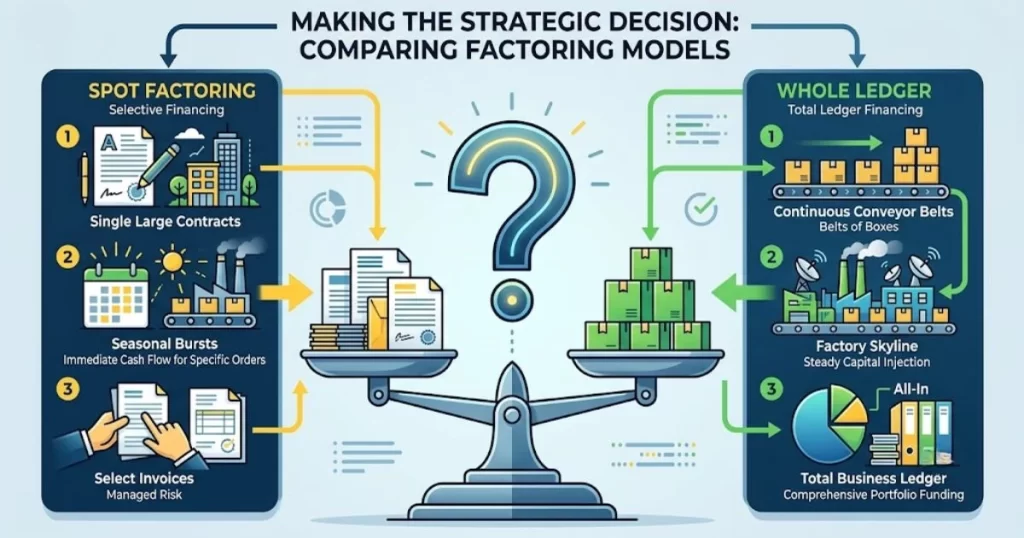
Spot factoring is usually the smartest choice if your business matches these characteristics:
- Project-Based Operations: Construction firms, custom software developers, or commercial contractors who take on occasional high-capital projects requiring immediate upfront materials or subcontractor payments.
- Highly Seasonal Businesses: Companies that experience massive demand surges during specific months (such as retail suppliers before the holiday season) but run lean, cash-positive operations the rest of the year.
- Businesses with High Net Profit Margins: Operations with generous profit margins can easily absorb occasional single-invoice financing fees without damaging profitability.
- Firms testing Invoice Financing: Business owners who want to experience invoice factoring for the first time without locking themselves into multi-year financial agreements.
Ideal Scenarios for Whole Ledger Factoring
Whole ledger factoring is typically best suited for companies that meet the following criteria:
- Fast-Growing Enterprises: High-growth companies whose operational costs constantly outstrip cash collections due to rapid scale.
- Low-Margin, High-Volume Sectors: Businesses in staffing, wholesale distribution, or freight brokerage where tight profit margins require the lowest possible per-invoice discount rate.
- Companies Seeking Administrative Relief: Business owners who want to outsource customer credit checking, invoicing collections, and ledger tracking to free up internal overhead.
- Stable B2B Client Portfolios: Operations that serve a large group of creditworthy B2B buyers on standard 30-day to 60-day credit terms.
How to Choose the Right Factoring Partner
Once you decide between spot factoring vs whole ledger factoring, selecting the right financial provider ensures a smooth, productive partnership. Here is a step-by-step checklist to guide your decision:
- Verify Industry Specialization: Work with a factor that thoroughly understands your specific business sector. Transport companies, medical suppliers, and construction firms each face unique invoicing nuances that require specialized underwriting knowledge.
- Review Fee Transparency: Ask for a comprehensive schedule of fees in writing. Ensure there are no unexpected charges for credit checks, invoice upload fees, minimum monthly volume shortfalls, or account setup.
- Evaluate Collection Methods: Understand how the factor communicates with your clients. Professional funding providers act as an extension of your customer service team, maintaining courteous, respectful collection standards that safeguard your client relationships.
- Assess Platform Integration: Ensure the factor’s software connects smoothly with popular accounting systems like QuickBooks, Xero, or Sage. Automated invoice syncing saves hours of manual administrative effort each week.
Frequently Asked Questions
Will my customers know I am using spot factoring or whole ledger factoring?
Yes, in most commercial factoring arrangements, your buyers receive a formal Notice of Assignment (NOA). This document informs them that payment should be directed to the factor’s secure lockbox or bank account. Customers view this as standard business practice across competitive commercial industries.
Is spot factoring more expensive than a traditional bank loan?
On a strict annual interest rate basis, invoice factoring costs more than a traditional bank line of credit. However, factoring is far easier to qualify for, requires no asset collateral, carries no debt on your balance sheet, and provides instant cash flow within 24 to 48 hours.
Can I transition from spot factoring to whole ledger factoring later?
Yes. Many growing companies start with spot factoring to solve short-term cash crunches. As their order volumes rise and working capital demands become continuous, they negotiate whole ledger agreements to secure lower overall transaction fees.
What happens if a customer refuses to pay a factored invoice?
If you hold a recourse factoring agreement, your business must replace the invoice or repay the advanced funds. If you carry non-recourse factoring and the non-payment is caused by client bankruptcy or insolvency, the factor absorbs the loss.
Final Thoughts on Spot Factoring vs Whole Ledger Factoring
Understanding the key differences in spot factoring vs whole ledger factoring allows you to make an informed financial decision tailored to your operational needs. Spot factoring gives you ultimate flexibility, zero contract lock-ins, and complete control over single invoices, making it ideal for temporary cash squeezes or seasonal pushes. Whole ledger factoring offers lower individual fee rates, automated back-office receivable management, and steady funding for high-volume, rapidly scaling enterprises.
By analyzing your annual revenue patterns, client payment terms, and profit margins, you can implement the invoice financing strategy that optimizes working capital while keeping financing costs as low as possible.
Take Control of Your Business Cash Flow Today

Struggling with slow-paying clients and tight working capital? Don’t let unpaid invoices slow your company’s growth. Contact our corporate financial specialists today through our Contact Us Page to get a customized, obligation-free invoice factoring quote designed specifically for your cash flow goals.