
Many small business owners face a regular, exhausting struggle: waiting 30, 60, or even 90 days for commercial clients to pay their bills. When your capital is trapped in outstanding invoices, covering payroll, buying raw materials, or taking on new contracts becomes incredibly stressful. Traditional bank loans often require years of perfect financials or heavy collateral, leaving fast-growing startups and seasonal businesses in a tough spot. To bridge this gap, many companies turn to accounts receivable financing to get paid immediately.
However, a major roadblock often appears when looking for a financing partner. Most providers lock you into restrictive, long-term contracts that require you to fund a massive amount of receivables every single month. If your sales dip or a major contract wraps up, you get hit with expensive penalties just for falling short of your quota. Fortunately, partnering with no minimum volume invoice factoring companies solves this issue completely. These flexible financial providers give you the immediate capital your business needs without forcing you into restrictive volume quotas, allowing you to fund only the invoices you want, exactly when you need it.
What Exactly is No Minimum Volume Invoice Factoring?
To understand why a flexible arrangement is so valuable, it helps to break down how traditional factoring contracts operate. In a standard agreement, a funding provider looks at your annual or monthly revenue and sets a strict baseline. For instance, they might require you to factor at least $50,000 worth of invoices each month. If your client volume drops or you simply do not need the extra cash that month, the provider still charges you a “minimum usage fee” to make up for their lost profit.
A no-minimum volume plan completely removes this structural pressure. Under this flexible model, you are granted a factoring line, but you maintain full control over how and when you use it. You can choose to factor a single large invoice during a tight month, and then go three months without factoring anything at all, without incurring hidden fees or low-volume penalties.
Why Traditional Volume Minimums Can Stifle Small Business Growth

For a corporate giant with highly predictable monthly revenue, committing to a fixed financing volume makes perfect sense. Funding providers offer slightly lower rates in exchange for guaranteed, high-volume steady business–much like buying inventory in bulk. But for small businesses, startups, and rapidly scaling service firms, these rigid quotas can quickly become financial traps.
The Problem with Unpredictable Revenue Cycles
If your business experiences natural seasonal dips, contract-based work, or uneven client payment schedules, your revenue is far from a straight line. Imagine committing to a $30,000 monthly volume minimum during your busiest quarter, only to enter a quiet summer where you only generate $10,000 in billings. Under a traditional contract, you would have to pay a shortfall fee out of pocket, completely erasing the cash flow benefits the financing was supposed to provide.
The Danger of Over-Factoring
When you are forced to meet a monthly quota, you end up factoring invoices that you don’t actually need to advance. This means you are giving up a percentage of your hard-earned profits on clients who already pay reliably and quickly, just to keep your funding provider happy. Partnering with no-minimum alternatives ensures you only spend money on financing when it actively serves a strategic business purpose.
Key Benefits of Working with No Minimum Volume Invoice Factoring Companies
Choosing a provider that relies on flexibility rather than strict volume mandates offers several distinct operational advantages for your day-to-day operations:
- Total Control Over Invoice Selection: You decide exactly which clients and which specific invoices to fund. If you have one client who consistently takes 60 days to pay, you can factor their invoices while letting your 15-day paying clients clear naturally.
- Freedom to Pause Funding Entirely: During periods of strong cash reserves, you can stop factoring altogether. Your facility remains open and ready, but you aren’t charged a dime while it sits idle.
- Protection Against Client Turnover: If a major customer pauses a project or ends a contract unexpectedly, your business won’t face secondary financial penalties from your funder due to the sudden drop in active receivables.
- No Long-Term Commitments: Providers that offer no-minimum programs typically work on month-to-month terms or highly flexible, transparent structures rather than multi-year lock-ins.
How the Step-by-Step Spot Factoring Process Works
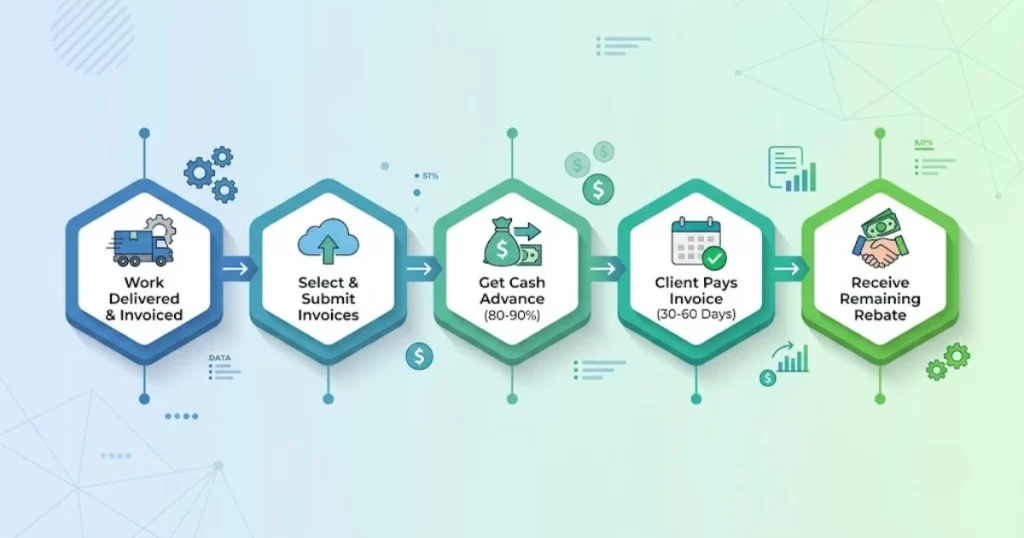
Because no-minimum volume factoring treats transactions with greater independence, it frequently utilizes a process known as “spot factoring” or “selective factoring.” The step-by-step workflow keeps things straightforward:
1.Deliver the Work and Invoice Your Customer:Step 1.
Provide your commercial services or goods to your B2B client exactly as agreed. Generate a clean invoice with clear payment terms (like net-30 or net-60 days).
2.Select and Submit Invoices for Funding:Step 2.
Log into your provider’s digital portal and upload only the specific invoices you want to advance today. There is no pressure to upload your whole ledger.
3.Receive Your Immediate Cash Advance:Step 3.
The financing company verifies the invoice and wires an upfront advance—typically ranging from 80% to 90% of the total invoice face value—directly to your bank account, often within 24 hours.
4.The Client Pays the Invoice Balance:Step 4.
Your customer pays the invoice amount directly to the secure payment address setup by the funding provider at the end of the standard 30- or 60-day window.
5.Collect the Remaining Rebate Balance:Step 5.
Once the payment clears, the provider sends you the final remaining balance (the 10% to 20% held back), minus their small percentage fee for processing the transaction.
Comparing Your Financing Options: At a Glance
To see how these programs stack up against standard industry funding, let’s look at a straightforward comparison of the key structural terms:
| Feature | No-Minimum Volume Factoring | Traditional Invoice Factoring |
| Monthly Volume Requirement | Completely None | Fixed dollar amount ($10k-$50k+) |
| Low-Volume Financial Penalties | None | Shortfall or minimum usage fees |
| Invoice Selection Freedom | You pick individual invoices | Whole-ledger or all-client mandates |
| Contract Commitments | Often month-to-month or open | Strict 1 to 2-year lock-in terms |
| Average Pricing Rates | 1.5% to 4.0% per 30 days | 1.15% to 3.5% per 30 days |
Industry Insight: “While no-minimum plans might carry a slightly higher base discount rate than high-volume corporate contracts, they are almost always significantly cheaper for small businesses in the long run,” notes senior corporate credit specialist Marcus Vance. “The small fraction of a percent difference in the base rate is completely eclipsed by the heavy shortfall penalties businesses avoid when their sales fluctuate naturally.”
Understanding the True Cost: Rates and Fees Explained
When you work with a provider that doesn’t demand volume commitments, pricing is calculated transparently on a deal-by-deal basis. Standard factoring fees generally fluctuate between 1.5% and 4.0% per 30 days that an invoice remains open.
Your exact rate depends on three primary factors:
- The Creditworthiness of Your Customers: Because the funding company is collecting from your clients, their commercial payment track record matters infinitely more than your personal credit score.
- Days Outstanding: A flat fee structure charges you one set percentage regardless of when the client pays. A tiered fee structure increases slightly every 10 or 15 days until your customer clears the balance.
- Individual Invoice Size: Even if there is no total monthly volume cap, many providers prefer that an individual invoice meets a baseline size (e.g., $500 or $1,000) simply because processing tiny invoices can become operationally inefficient.
Real-World Example: Navigating the Off-Season Seamlessly
Let’s look at how this plays out for a business project. Consider a B2B commercial landscaping and facility maintenance company. During the peak spring and summer months, they generate roughly $80,000 a month in corporate invoices. They use factoring regularly during this phase to buy bulk supplies and keep up with bi-weekly field payroll.
When winter hits, their commercial revenue drops down to a modest $8,000 a month for basic grounds upkeep.
- Under a traditional contract: If they had signed a facility requiring a $30,000 monthly minimum volume, they would face massive shortfall fees all winter long, creating a major cash drain right when they are most vulnerable.
- With a no-minimum volume provider: They simply scale down their usage naturally. They choose to factor just one $5,000 invoice in December to ensure their core office team gets their holiday bonuses on time, paying a modest fee only on that single transaction. The rest of the winter carries zero financing overhead.
What to Look For When Choosing a Flexible Funding Partner
Not all flexible financing programs are built equally. When vetting potential no minimum volume invoice factoring companies, make sure to ask direct questions about these hidden contract elements:
- Are there hidden “Facility Fees”? Some providers proudly claim they have zero volume requirements, but they charge a hidden monthly administrative or maintenance fee just to keep your account open. Look for partners who only charge fees when an invoice is actively being advanced.
- Is it a true non-recourse or recourse setup? Recourse factoring means your company must buy back the invoice if your customer completely defaults on payment. Non-recourse provides protection if the client goes bankrupt, though it may carry a slightly higher rate.
- What are the processing speeds? The primary goal of resolving accounts receivable issues is speed. Ensure your chosen partner provides a smooth digital onboarding platform capable of delivering ACH or wire deposits within 24 hours of approval.

Conclusion: Take Back Control of Your Cash Flow
Waiting endlessly for clients to pay invoices shouldn’t stand in the way of running your daily operations or scaling your business. By partnering with strategic no minimum volume invoice factoring companies, you unlock the ultimate financial safety net: immediate cash flow whenever you experience growth spurts, combined with absolute freedom to walk away during quieter operational stretches. You maintain complete authority over your client relationships, your invoice selections, and your bottom line profits.
Stop letting rigid, old-school funding quotas dictate how you manage your corporate capital. If you are ready to implement a flexible, reliable capital setup tailored strictly to your company’s natural ebbs and flows, we are here to assist you every step of the way. [Contact our advisory team today] to explore a customized, zero-obligation financing structure designed around your specific business goals.